
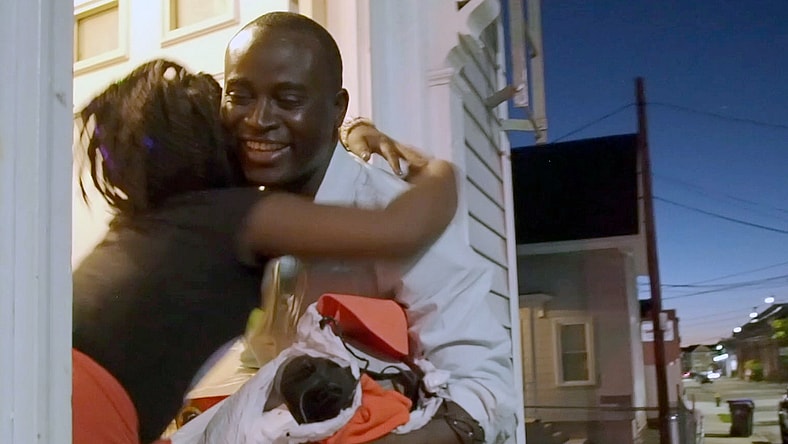
Dr. Omar Bah became a journalist by walking into a newspaper in his home country of Gambia and offering to help expose government corruption. For his courage, he was tortured by the people he tried to expose, and eventually fled Gambia for fear that he would be murdered by the regime of the country’s then-president.
Bah’s escape from Gambia — and what happened next — is the subject of the new documentary Unbowed, by Mae Gammino and David Helfer Wells. It recounts how Bah started a new life in Rhode Island, and founded the Refugee Dream Center, a nonprofit dedicated to helping refugees find jobs, education, employment and housing — as well as a sense of community.
The film, which airs Friday on Rhode Island’s Ocean State Media/RI PBS and will also be available on the station’s site, follows Bah through a crucial year, and arrives at a perilous time for refugees and all immigrants to the United States.
Gammino, who previously produced the documentary Being Thunder, came to filmmaking after owning a manufacturing business and then becoming a photographer — skills that proved essential to making Unbowed. She realized Bah’s story should be a film, and enlisted Wells, a photojournalist and filmmaker who had helped her when she was starting out in photography.
One of the biggest challenges they faced was just getting time with the very busy Bah — who in addition to his careers as an activist and journalist, earned a doctoral degree in neuropsychology in 2020, and ran for Congress in 2022.
We asked Bah, Gammino and Wells about authoritarianism, parallels between Gambia and the United States, and how sharing Google calendar access made Unbowed possible.
MovieMaker: Omar Bah became a journalist by walking into the office of a small newspaper in his native Gambia and offering to work there. Contrary to popular belief, high-stakes journalism is a skill with rules and best practices that most people can’t just do, just walking in off the street. What are the remarkable qualities that enabled Omar to have an impact despite having no experience?
Omar Bah: At the time of walking into the offices of The Independent Newspaper, my only qualification was passion and vision for a free Gambia devoid of corruption, repression, and human rights abuses; a Gambia where everyone had a voice. I grew up in a small rural village. At the time, there was no running water, electricity, or school. I was one of the very few children who had access to education and had to walk long distances to get to the nearest school.
I am from a collectivist, extended family system where my father had three wives and about 20 children. My mother alone had eight children. Because my mother is the first wife, I am the second child for both my mother and father. This position in terms of child seniority comes with a huge responsibility. My older brother was battling with an epilepsy condition. By default, as a child, I had to step in to act as the first child.
As a result, I helped my mother with babysitting, pounding grains and wheat, running errands, fetching water, and almost every hard labor I could do. My mother was being subjected to domestic violence. I deeply sympathized with her and would cry along with her, and support her at every moment of distress. As a woman who was married as a young teenager, my mother went through untold suffering.
This experience imbued in me a strong sense of advocacy, a sense of justice. I did not want to see other young women like my mother marry in their teens rather than be in school. I did not want to see young women like my mother experience domestic violence and extreme levels of hard labor.
This orientation took me to an undergraduate pre-law program because I wanted to be a lawyer to advocate for those who were experiencing struggles similar to those of my mother. Once I started these studies, and realized that the maximum I could study was two years for lack of a complete law program in the country, I devised a means to continue my advocacy and promotion voices of the people, and justice. This led me to walk into that newspaper office in the year 2000.
Mae Gammino: I believe it was the conditions of Omar’s upbringing that shaped his need to help others have meaningful lives. Omar is highly perceptive, especially with understanding how systems work, any system. This, coupled with his superior intelligence, boundless energy, curiosity, empathy and equanimity, helps him devise strategies to achieve goals successfully.
And — two traits that don’t receive enough credit as important to success — Omar is sincere and earnest. So it’s no surprise to me that he had the self-confidence to walk into an editor’s office, as an inexperienced young person, and pitch himself for a reporting job, and then harness grit to learn how to do it to excel. He recounts this story in the film, and it’s one of my favorite scenes.
David Helfer Wells: I can’t speak for Omar, but I will point out that I did a somewhat similar thing to what he did when I started as a photo journalist four decades ago. I had the technical skills as a photographer, but I certainly needed to learn the basics of journalism, because I didn’t actually study those in college. I learned those things on the job at a small newspaper in Southern California, where I got my start.
I quickly realized that my primary strengths, which I think Omar also had, were curiosity, empathy, lots of energy, a willingness to listen to people, and a desire to share what I learned in that process. As I got to know Omar, I saw all of those things in him, so it wasn’t a surprise that he had succeeded as a journalist.
MovieMaker: Do you see parallels between what Omar dealt with in Gambia and what’s happening in the United States now?
Mae Gammino: Omar can speak to this in a more informed way because he lived under a brutal and repressive dictatorship for about 22 years, and now has lived in the U.S. for 18 years, which included Trump’s first presidency. That said, I see a parallel in that we have a president, administration, and congressional majority that support the Unitary Executive Theory, which is being used with countervailing measures minimally present. Unless one feels protests and lawsuits have been effective, they’re pretty much continuing unimpeded. It’s mind-boggling.
Omar Bah: I see parallels between what I dealt with in The Gambia and what is happening currently in the United States, although differently. Back home, in The Gambia, I was arrested and tortured by government forces on several occasions. I still have torture marks, and I still peel dead skin from one of the deep wounds I got from such tortures.
Media houses were firebombed, forcibly shut down and several journalists including myself eventually fled the country into exile. It is slightly different in the U.S. as one can argue about a hostile media environment where journalists have been disparaged and disrespected by members of the presidency. However, they still continue to separate freely and the extremes have not been realized yet. However, the signs are all there for a deterioration into a chaotic situation.
David Helfer Wells: I certainly see parallels between what’s going on in this country and the anti-democratic political culture that Omar came of age in, and then that he eventually reported on the inequities of.
MovieMaker: How did you all first meet?
Mae Gammino: I met Omar first in 2016 at a Refugee Policy conference in Providence — David was working overseas and could not attend. Trump’s language about immigrants and refugees was gaining significant press coverage. I wanted to learn more about refugee policy and what I could do in Rhode Island to help our local refugee community, though not as a journalist, as a private citizen.
Omar was a panelist, and his words were captivating. I was interested to know more about him, his wife, and the organization they had recently created, the Refugee Dream Center. I pitched David on the idea to do some sort of project about Omar, and then arranged for us to connect with him and his wife at their office. After this meeting, we discussed making a small profile piece that would involve a handful of shoots, but as we spent more time with them we realized a deeper story existed.
We filmed the majority of the footage over one year and then made a small profile piece for Omar to use on his website. We had intended to cut a longer film too, but other projects and work commitments put this plan on hold. However, we kept in touch with Omar and over the years filmed more, including some very recent footage after Trump was elected. Strangely enough, it the downtime of Covid that provided us time to revisit footage and make a plan to finish the film.
David Helfer Wells: I met him early in the development of the organization that he now runs, the Refugee Dream Center. We initially were thinking of doing a short film/profile on him, but as we got to know him and learned about his life in the Gambia, the new life he was building in the U.S., and then when we met his family, we realized there was a much deeper and richer story there.
Omar Bah, Subject of Unbowed, on the American Dream
MovieMaker: As an immigrant who saw the United States as a place of refuge — and as the founder of the Refugee Dream Center — how does Omar feel about the recent ICE actions and the state of the U.S.?
Omar Bah: It has been 18 years since I arrived in the U.S., and still cannot fully believe that I am actually deserving and/or really that special to be given such a special opportunity. Imagine being a torture survivor, wallowing in distress in the stress of another country, Ghana, and then, out of all the countries of the world, and out of the millions of refugees displaced across the world, I was among few that got the once in a lifetime opportunity to be resettled in the U.S.
I have been particularly grateful for that. I am also particularly grateful for the opportunity for my children to be born in the U.S.A. That is why I started the Refugee Dream Center. To continue my lifelong passion and vision of advocacy and social justice, but also to imbue the sense of the American Dream of hard work and success on fellow refugees, hence the name of the center.
I believe this is my special way of expressing gratitude to the country, but also ensuring I contribute to the continued economic and social growth of our society. Thus, it pains me to see how ICE and our government has been scapegoating immigrants and treating them in a very dehumanizing way.
Mae Gammino: Personally, I find their actions appalling and inhuman. I believe this administration’s objective is to control by promulgating fear and intimidation.
David Helfer Wells: As someone who is now married to an immigrant, I find the entire anti-immigrant/anti-refugee political posture of the Trump administration to be appalling.
MovieMaker: What was your biggest challenge in making Unbowed? How did you overcome it?
Mae Gammino: This was my first go at making a documentary — David had made a few shorts before this experience. Personally, I was figuring it out as we went along. It was later in the editing process that I really understood and appreciated which of my inclinations, during production, had been correct and those which had not.
That said, the biggest challenge was getting time with Omar (I say this with true affection). He’s always in motion and does more in one day than most folks accomplish in a week. After becoming frustrated with trying to figure out how to get Omar to commit to filming, not because he was reluctant, he was just too busy to help us organize things, I realized that other than the product I was making — a film — my prior business experience had given me transferable skills to handle situations like this. Before becoming a photojournalist and filmmaker I owned a manufacturing company for 20 years.
I adjusted my thinking and reached out to his assistant to suggest I be added to his Google calendar, and presto — I was able to see his entire schedule months in advance. This allowed me to target specific events, and helped us have a complete picture of his activity, personal and business. Once the burden of having him help us schedule things was removed, it was easy to arrange what we wanted to film.
It was also the game-changer for us and Omar, especially because the more time we spent together he was increasingly less formal and began to notify us of things we might want to film.
The other impediment, which we could not completely overcome, was that David and I we making this film in our spare time, which meant we could not film as often as we needed and wanted. However, with these challenges met, the wonderful result for us and Omar was the warmly received international premiere in Nigeria last month. Their media celebrated it as story of triumph over repression and violence through an African’s magnanimity towards his fellow refugees prominently featured in an uplifting documentary.
David Helfer Wells: We were able to film the situations we needed. In hindsight, we should’ve filmed even more of his life, because when it came to editing, we still came up short on B-Roll and on showing all the interesting aspects of his life.
MovieMaker: During Omar’s 2022 run for Congress, he pledged not to attack or disparage any other candidates. How is that approach working for him? Does he remain committed to it?
Omar Bah: I stayed through to my pledge, as I saw politics differently. Actually, my campaign slogan was to “Defend The Dream,” and thus, my only objective was to contribute civically and socially to the augmentation of the lives of the people in my district and the country at large.
Thus, I was not interested in the disparaging tactics of the many political actors. I remained positive in my campaign. Despite not winning, I felt like participating in such a large political platform was a way of further expressing gratitude to the country, but also promoting equal opportunities for everyone who sees this country as a beacon of hope for all.
I do not see politics as a career, and thus, such a run was not meant to be a lifetime of candidacy. I am, however, glad I did pave the way for others and proved that anyone can be anything in this country.
MovieMaker: Finally, Mae and David, can you detail how you became filmmakers?
Mae Gammino: I made a career change a little over a decade ago, from manufacturing business-owner to photojournalist, and film producer/director more recently. I’ve shot assignments as varied as a U.S. Joint Military Humanitarian Aid Mission in Indonesia to stills photography for a film in Utah, as well as assignments for local and national newspapers and magazines. My training involved some adult ed evening photography courses at RISD — I have no formal training in film and producing.
Over the years I gained exposure to the film industry as the staff festival photographer for the Provincetown International Film Festival and attending Sundance. I’d always had a desire to make documentaries but did not believe I could without attending film school. However, being around filmmakers at these festivals was the needed catalyst, and they became my film school though meeting filmmakers, attending panel talks, and simply being inspired and motivated by what I’d been exposed to. I even met the director of my first documentary, Being Thunder, on a shuttle at Sundance.
I also can’t dismiss the importance of having had a full career before this as a manufacturing business-owner. It provided a perspective about business and practical skills one needs in any industry.
I also was fortunate to find David. He was my mentor when I first started as a stills photographer, and through the years we’ve collaborated on commercial jobs and helped each other on some of our respective projects.
Even though I came into this business late in life, it’s not been an impediment, many of my initial film opportunities came from Get X and Millennial filmmakers. And, to date, I’ve been able to complete two films of my own, both of which I am very proud because they’ve introduced two remarkable Rhode Islanders to many people across the country and world.
David Helfer Wells: I’m an award-winning visual storyteller based in Providence, Rhode Island, and my path to filmmaking grew naturally out of a lifelong commitment to visual journalism and human-centered storytelling. I began my career as a photojournalist, spending decades reporting deeply researched photo essays for publications such as National Geographic, Life, Time, Newsweek, Fortune, and The New York Times Sunday Magazine.
One of the most formative moments of my career was a Pulitzer Prize–nominated photo-essay on the pesticide poisoning of California farm workers for The Philadelphia Inquirer. That work, and many projects like it, shaped my belief that images can bear witness, demand accountability, and illuminate lives too often pushed into the margins.
Over time, still photography no longer felt sufficient to capture the complexity, silence, motion, and emotional rhythms of the stories I was encountering. I turned to documentary filmmaking as an extension of my visual practice, drawn to the way light, shadow, stillness, and movement could deepen narratives. My films champion intercultural storytelling and explore urgent social issues through an immersive cinematic language.
Unbowed airs Friday on Ocean State Media/RI PBS and will also be available on the station’s site.
Main image: Omar Bah in a scene from Unbowed.